
When Sanford Housing Authority (SHA) decided to bring recycling to two of its properties, the goal wasn’t just to divert waste. It was about doing right by the people who call those properties home.
SHA supports approximately 1,100 individuals and families across the Sanford area, with a mission rooted in providing safe, quality, and affordable housing, and creating opportunities for growth and development for residents and the community. Executive Director Diane Small believes this mission and environmental responsibility go hand in hand.
“Recycling in multi-family housing, especially in senior communities, goes well beyond environmental benefits,” she said. “It directly supports resident well-being, housing stability, and community pride.”
Partnership in Practice
In fall of 2025, the Multi-Family Recycling Initiative (MFRI) launched programming to bring recycling access to two SHA properties: The Maples and Mayflower Place. Neither property had recycling available to residents when conversations began.
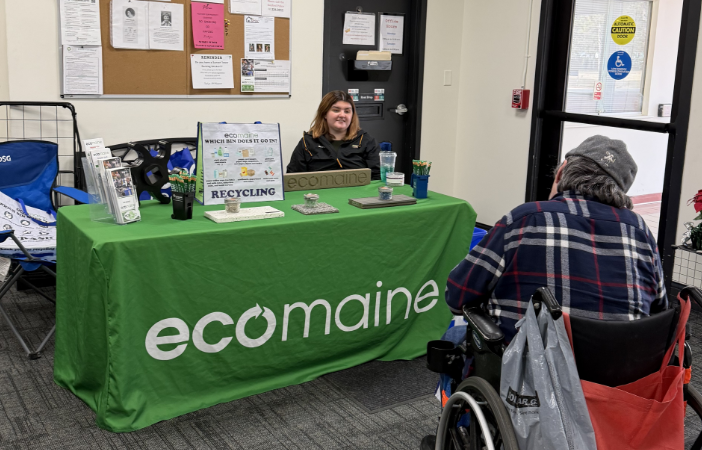
Going beyond handing SHA a recycling bin and a brochure, the MFRI team worked alongside SHA staff from the ground up. This collaboration included reviewing the current waste setup, providing recommendations on infrastructure changes, and rolling out a 10+ week resident education program that included weekly waste audits, direct resident outreach, presentations, and tabling events. SHA staff coordinated each building’s recycling dumpster installation logistics, enabling immediate resident participation.

SHA assesses existing corrals, to explore options to accommodate recycling infrastructure
For Randy Levangie, Director of Maintenance and IT, the collaborative approach made all the difference: “Partnering with ecomaine gave us the opportunity to have the tenant education and interaction piece; residents learned why and how to recycle.” For the MFRI team, education and resident engagements are where their value lies most, and the piece that makes real results possible.
Why It Mattered
Small describes recycling access as a matter of dignity. “Many of our senior residents have recycled for decades and expect to be able to continue doing so. When recycling isn’t available or is difficult to access, it can feel like a loss of independence or a step backward.” Providing that access, she says, allows residents to maintain routines that matter to them.
On the operational side, Levangie described his motivation to institute recycling as “helping the environment as well as saving costs on our waste hauling.” This combination resonates with housing staff everywhere, doing good and managing budgets aren’t mutually exclusive.
Measuring Impact
Once recycling was introduced, the results came quickly.

A note on audit methodology: contamination and diversion data is collected through non-invasive visual waste audits. Our team assesses the volume and visible contamination of materials at the surface of the recycling containers, which is then used as a representative sample of the container as a whole.
Across both properties, residents diverted over 600 pounds of materials from the landfill over the course of programming (~10 weeks), a meaningful number for two communities that didn’t have a recycling program just weeks before. The Maples saw a 43% diversion rate, meaning 43% of all waste generated was recovered through recycling rather than sent to the landfill. Mayflower Place followed at 33%. To put those numbers in context, only 21% of recyclable material is currently being recycled across the U.S., and of everything that doesn’t get recycled, 76% is lost right at the household level, never collected at all [1]. These numbers tell us that access and education are not just helpful, but essential.
Perhaps the most compelling: both properties achieved just 3% contamination. To put that in perspective, the U.S. average inbound contamination rate (non-recyclables ending up in recycling) is around 17% by weight, and can hit 40% or more in some areas [2]. SHA’s properties came in at a fraction of that average. That success is not luck, it’s education working exactly as intended.

Emily, MFRI Project Coordinator, audits recycling at Mayflower Place
Community in Action
The numbers tell part of the story. Misty White, Property Management Assistant for both properties, puts the experience into words.
“The biggest surprise I see is how easy it was once we worked out a few bugs,” she said. “Some tenants came together to help others physically take out their recycling and offered tips and suggestions to encourage it to be successful.”
Neighbors helping neighbors. Residents stepping into the role of informal ambassadors. That’s the kind of outcome you can’t manufacture, but you can create the conditions for it.
Small speaks to what that community ownership means on a broader level.
“Recycling builds community. In our senior properties, we see residents take pride in doing things the right way. It becomes a shared norm that fosters cooperation and neighbor-to-neighbor support.” She also points to what it gives residents on an individual level: “Many of our residents want to feel they are still contributing in meaningful ways. Recycling offers a simple, everyday action that reinforces that sense of contribution- supporting not just environmental goals, but personal agency and community engagement.”
What’s Next
The results at The Maples and Mayflower Place didn’t go unnoticed. That success, and the relationships built along the way, led to expanding the partnership. Village View and Sunset Tower, two additional SHA properties, now have active programming underway, with early resident feedback coming in positive.
The work doesn’t stop when the programming does. Since wrapping up at The Maples and Mayflower Place, the MFRI team has provided recycling materials for resident move-in kits and returned for a six-month waste audit to evaluate lasting impact. This follow-through matters, because recycling education can’t be a one-time event, especially not in multi-family housing. Habits take time to form, residents change, and momentum needs to be maintained. That’s why the Multi-Family Recycling Initiative equips property staff with the resources and tools to keep the conversation going long after the program’s intervention, so the impact lives within the community, not just alongside it.
Success like this doesn’t happen without an invested partner. SHA staff didn’t just unlock the dumpsters and hope for the best, they engaged their residents, and leaned into the process at every step. That kind of commitment is what turns a pilot program into a lasting system. SHA started with two properties and no recycling infrastructure. They now have four active sites, a growing culture of resident recycling participation, and a team that has become a model for what this partnership can look like at its best.
Ready to Get Started?
Starting a recycling program doesn’t have to mean figuring it out by yourself. Lean on the MFRI team to help you!
The Multi-Family Recycling Initiative offers everything a property needs to improve or start a recycling program, at no cost. That means boots on the ground, resident education, communication templates, signage, outreach materials, waste audits, and hands-on support from our team every step of the way. There’s no need to figure out the logistics, source the materials, or design the education program yourself. We bring it all.
Whether your property lacks a recycling program or has one that isn’t quite working, we are here to help you build something that lasts and makes an impact. Reach out to us at multifamily@ecomaine.org to learn more, and let’s build better recycling together!
Footnotes
[1] The Recycling Partnership. (2024). State of Recycling: The Present and Future of Residential Recycling in the U.S. The Recycling Partnership. https://recyclingpartnership.org/residential-recycling-report/
[2] The Recycling Partnership. (2020). 2020 State of Curbside Recycling Report. The Recycling Partnership. https://recyclingpartnership.org/wp-content/uploads/dlm_uploads/2020/02/2020-State-of-Curbside-Recycling.pdf
