
Every year, we ask the communities we serve a simple question: who’s doing the work to build a more sustainable Maine?
That work might not be flashy or high-profile. We ask you to look around at your neighbors and let us know who’s rolling up their sleeves and doing the consistent, unglamorous, keep-showing-up work: diverting food scraps from landfills, teaching a roomful of fifth graders what single-use plastic actually costs, or making sure a senior living in affordable housing has a clear path to a recycling bin, even during a heavy snow year.
The eco-Excellence Awards exist to answer that question. This year, we received nominations across six categories, and the caliber of work we read about reminded us that sustainability isn’t one big movement. It’s hundreds of small ones, happening in coffee shops, classrooms, housing authority properties, and municipal transfer stations across Maine.
Here are the people and organizations who stood out.
Kelly Greenlee
Individual Award
Prince Memorial Library, Cumberland
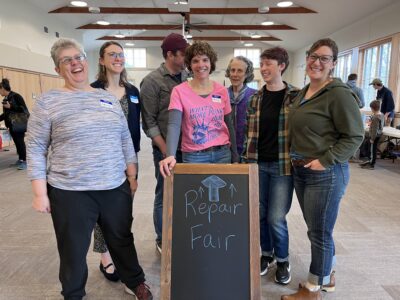
As Community Outreach Librarian at Prince Memorial Library, Kelly Greenlee has spent years cultivating a hub of activity that invites people to explore much more than books. Under her leadership, PML has become a beacon of sustainability, part repair & reuse culture, and neighbor-to-neighbor meeting spot.
On any given visit to Prince Memorial, you may drop off recycling, swap a piece of clothing, get a broken zipper fixed, or borrow a power drill. Once you’re finished with that, you’ll still have time to return your novels before you leave.
The programming, spearheaded by Kelly, reflects this mix. Repairs Fairs, Junk in the Trunk free-cycling, gear swaps, a ‘Thrift & Sift’ clothing swap, a Library of Things lending program, and regular visits from the ecomaine educators: each event opens a different door into sustainability – different ages, different budgets, and different entry points. Together they’ve pulled in participants from well outside the two communities PML officially serves.
Working hard to build partnerships across municipalities, Kelly and Prince Memorial Library continue to expand their scope. When you build good relationships and good programming, you don’t have to convince people to show up – they begin to grow on their own and take on a new life. Kelly has sparked the programs’ success by making sure they are consistently worth showing up for.
Reverie Coffee House
Business Award
Brunswick

When you walk in to Reverie Coffee House, you’ll notice something before you ever order: signs explaining the composting bins, the Okapi Reusable Cup Program, and the discount you receive for bringing your own to-go mug from home.
This intentionality comes straight from the owner behind the shop, Hannah Josselyn. “Reverie comes from my heart,” Hannah explains. “It’s an extension of myself and what I want to give to the world.” The name itself, Reverie, means to get lost in one’s daydreams. That’s exactly what Hannah built: “a safe place, a happy place, a place where strangers become friends who become family.”
For Hannah, sustainability fits into that vision as a core value of the shop – an essential component of its culture. “Sustainability to me isn’t about being perfect, it’s about being intentional with the choices we make every day. Environmentalism means recognizing that even small businesses have an impact and using that as an opportunity to do better where we can.”
So, what does this mean in practice? Reverie works in partnership with Maine Compost Co. & Tripping Gnome Farms to handle all coffee grounds and food waste generated at the shop – avoiding the landfill completely. Attempting to avoid single-use plastic entirely, Reverie offers in-house mugs for dine-in customers to choose from via their mug wall near the front of the cafe. For customers taking their beverages to go, the Okapi program allows customers to download the app, pay a small fee, and scan a QR code to receive their drink in a stainless-steel reusable mug that is then returned to the shop within two weeks, sanitized and cycled back into use for future orders. Any customer visiting with their own reusable mug receives a discount at the register, discouraging the use of single-use plastic wherever possible.
Hannah will be the first to tell you that they’re still figuring out and learning as they go – but Reverie’s determination to make every choice sustainable invites all their customers to be part of the small daily changes that add up to big impact. For any coffee shop looking for a place to start, look no further than Reverie Coffee House.
Thomaston Grammar School Grade 5
Non-Profit, Community Group, or School Award
Thomaston
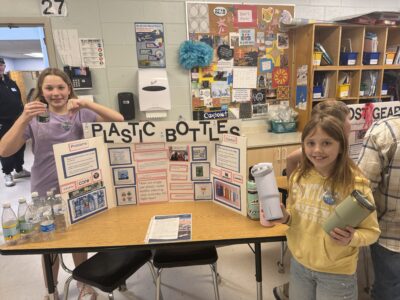
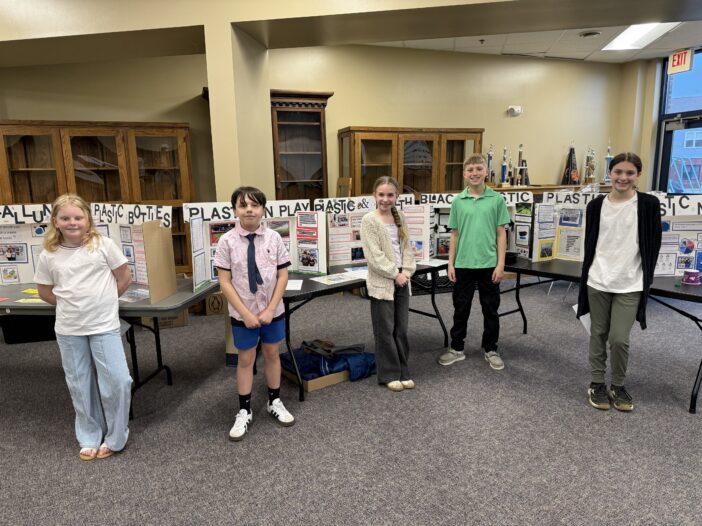
It all started with a fifth-grade class reading the non-fiction book, Trash Vortex. After reading, the students at Thomaston Grammar School decided they didn’t want to just learn about single-use plastic pollution – they wanted to do something about it. Over the course of a week, the students collected, sorted, measured, and graphed the single-use breakfast plastics coming from nine different classrooms. They wanted to repurpose these materials: cereal bowls became seedling starters, plastic spoons became plant markers for the garden, and sandwich bags became mini greenhouses.
Then, on March 11th, 2026, these students hosted a school-wide Plastic Pollution Showcase. By all accounts, the students saw real value come out of the showcase. And with multiple nominations for the eco-Excellence Award this year, we’d have to agree.
“As they were listening to how bad the environment was with plastic, I saw their faces in shock,” said student Evie C.
“A lot of people looked worried about plastic and some said, ‘I’m going to use reusable materials instead of plastic!'” added Evie F.
Juliette said “I’m very proud about that,” when discussing the pause people take when going to throw something away, reconsidering whether it has another use or can go into the recycling instead.
The students’ efforts throughout the school have created a conversation about plastics and ways to reduce and reuse these items. Up next? These same students will present their science boards & findings at a televised RSU 13 School Board meeting.
These students collected their own data, designed their own solutions, and presented it all to their school. We couldn’t be more excited to recognize this class, and we can’t wait to see what they do next.
Portland Housing Authority
Multi-Family Housing Leader Award
Portland
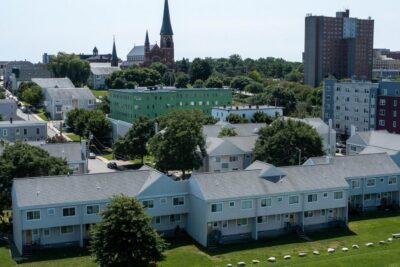
Sustainability in the affordable housing space comes with a different set of constraints. These programs must be designed to fit the residents’ unique needs. For programs to succeed, they need to be flexible, accessible and work into residents’ lives without adding extra stress or barriers. Portland Housing Authority understands that, and they have spent years building a program that reflects that.
Before rolling out a new program, PHA surveys residents to understand their specific challenges and hurdles around trash and recycling. From there, communication is delivered through multiple channels: newsletters, mobile push notifications, signage tailored to each property, and community cleanups led by CHEETA interns who are active in these communities themselves. To pair with this, PHA has partnered with our Multi-Family Recycling Initiative to improve waste management & recycling rates at a handful of their properties.
Portland Housing Authority has also focused on improved infrastructure for their buildings, installing rooftop solar panels on ten of their multi-family buildings. This covers approximately 250 units across the ten properties. With these panels in place, nearly 1.8 million pounds of CO2 emissions will be avoided over the next decade. Add partnerships with neighborhood organizations into the mix, and the reach of sustainability programming extends far beyond what PHA staff can on their own.
What Portland Housing Authority is proving is that resident-first, sustainability focused housing doesn’t have to be a luxury; it can be the bar all property owners strive for. ecomaine is proud to recognize PHA for all of the hard work they have done and continue to do on a daily basis.
Claire Carter
Student Leader Award
Freeport
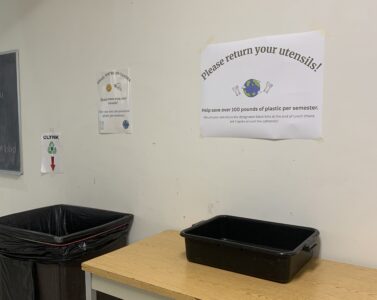
Before this year, the Student Leader award wasn’t recognized as a part of the eco-Excellence Awards. That was, until the committee reviewed the nomination for Claire Carter.
When the awards committee reviewed the submission for Claire, they saw an accomplished student, and president of the Freeport High School Earth Club, working tirelessly to further sustainability within her school and community. As the first recipient of the Student Leader Award, Claire immediately began thinking about the future. “I think this award opens the door for more youth recognition,” she noted. “Hopefully it will inspire more students to step up and realize the importance of student action.”
It began with plastic silverware in the school cafeteria, something Claire said she had noticed since freshman year. She led the Earth Club through researching alternatives, presenting to the principal and district director, and seeing the transition through to metal utensils. Then came the hard part: making sure it stuck. “If we didn’t help to ensure a smooth transition, the school would have to revert to plastic. We had to be the ones to make sure the changes lasted.”
To pair with the work Claire had done alongside the Freeport Earth Club, she also collaborated with her peers on a written testimony in support of LD 1543, the Act to Establish the Green Schools Network. For Claire, her work was never really just about the cafeteria. “It’s difficult to make a difference alone,” she said. “It takes a community, which is why we need to start in schools. You just have to start somewhere. Small things do make a difference, too.”
City of Sanford
Municipality of the Year
Population 22,247 | 27.2% Recycling Rate | 4 Years with ecomaine
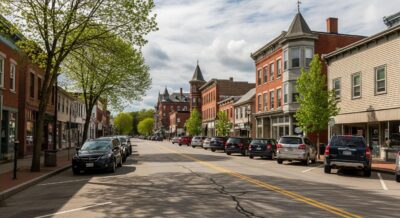
Sanford’s impressive array of sustainability programs seems easily enough for a dozen communities – but they’re all thriving in this one city in the heart of York County.
Over the course of the past year, ecomaine outreach touched National Night Out, a transfer station kickoff event, senior center presentations on composting and sustainable gift wrap, middle school recycling presentations, and a Green Team event.
But ecomaine education is just one component of an impressive commitment. Sanford’s Apparel Impact partnership to divert textile waste collected nearly 134 tons of textiles in its first year. Numbers like those show us that strong community participation, along with good program design, really can move the needle in a meaningful way. To anchor the city’s commitment to sustainability, the Sanford Energy Redevelopment Corridor Solar Project speaks to long-term goals on the infrastructure side.
Sanford’s work with ecomaine’s Multi-Family Recycling Initiative rounded out an already impressive year. The Sanford Housing Authority (SHA), alongside ecomaine’s MFRI team, started a pilot program with two properties totaling 61 units. By this spring, it had expanded to a majority of SHA’s multi-family properties, serving 173 units of older adult tenants, and had already diverted nearly 1,800 pounds of recyclables in just a few weeks. A lot of credit goes to Randy Levangie, Maintenance and IT Director at SHA, whose relationships with tenants helped generate genuine interest before the program officially launched.
With a recycling rate sitting at just over 27%, the City of Sanford is demonstrating that the work they’re doing is making a difference. But what stood out to our selection committee was the collective effort across the city, engaged residents, real working programs, and a community that’s made sustainability an integral part of how it operates.
A Note on the Awards
The eco-Excellence Awards are made possible by the nominations we receive from neighbors, colleagues, teachers, customers, and community members who took the time to recognize their neighbors. Thank you to everyone who submitted a nomination this year.
We want to recognize all of the nominees, whose impressive stories made our committee’s job a difficult one. Thank you for the work you are doing to make Maine’s future brighter. We look forward to hearing more about your work in future cycles.
To the six winners: thank you for what you do. We’re glad to be able to recognize it.
Interested in nominating someone for next year’s eco-Excellence Awards?
